
What eBike Classification is Right for You?

Read Time:5 Minute, 31 Second
Choosing an e-bike in 2026 isn’t as simple as just picking a color and a price. As the industry matures, the “Class System” has become the invisible law of the land. It dictates where you can ride, how fast you can go, and—most importantly—whether you’ll get a ticket from a park ranger or a police officer.
By early 2026, most U.S. states have tightened their grip on these classifications to improve safety and clear up the “grey area” between bicycles and mopeds. If you’re confused about whether you need a Class 1 for the trails or a Class 3 for your commute, this is your definitive 2026 guide to finding the right fit.
The Big Three: The Standard Classification System
Most of North America follows a three-class framework. This system exists to help land managers decide which bikes are “bicycles” and which are “motorized vehicles.”
Class 1: The Trail Purist
- How it works: Pedal-assist only. The motor only kicks in when you are actively pedaling.
- Speed Cap: 20 mph.
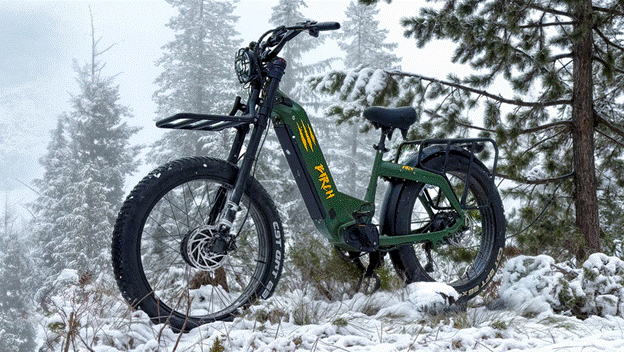
- The “Vibe”: This is the closest thing to a “real” electric hunting bike. It feels like you have bionic legs, but you still have to put in the work.
- Where to ride: Almost everywhere. Class 1 electric off-road bikes have the best access to mountain bike trails and multi-use paths.
- Who it’s for: Fitness enthusiasts, mountain bikers, and anyone who wants to stay active but needs help on the hills.
Class 2: The Accessible Cruiser
- How it works: Pedal-assist plus a throttle. You can twist a grip or push a button to move without pedaling at all.
- Speed Cap: 20 mph.
- The “Vibe”: Pure convenience. If you’re tired at the end of a long day, you can let the bike do $100\%$ of the work.
- Where to ride: Most city bike lanes and paved paths. However, many “non-motorized” dirt trails specifically ban Class 2 bikes because of the throttle.
- Who it’s for: Commuters who don’t want to arrive sweaty, riders with limited mobility, or casual neighborhood explorers.
Class 3: The Speed Pedelec
- How it works: Typically pedal-assist only (though some 2026 models have a “starting throttle” up to 20 mph).
- Speed Cap: 28 mph.
- The “Vibe”: Fast and focused. You can keep up with urban traffic, but the higher speed means you need to be a more experienced rider.
- Where to ride: Strictly on roads and dedicated bike lanes. In 2026, most states officially ban Class 3 bikes from shared-use paths and hiking trails due to the speed risk to pedestrians.
- Who it’s for: Long-distance commuters and “car-replacers.”
Comparison at a Glance
| Feature | Class 1 | Class 2 | Class 3 |
| Top Speed | 20 mph | 20 mph | 28 mph |
| Throttle | No | Yes | Usually No* |
| Trail Access | High (MTB Trails) | Moderate (Paved) | Low (Road Only) |
| Minimum Age | None (Usually) | None (Usually) | 16 (Typical) |
| Helmet Law | Under 18 | Under 18 | All Ages (Mandatory) |
The “Class 4” and Out-of-Class Revolution
In 2026, we are seeing a massive surge in high-power bikes (1000 W to 3000W) that can hit 45 mph. These are often marketed as “off-road e-bikes,” but the law is catching up.
If a bike can exceed 28 mph or has a motor larger than 750W, it is legally no longer an “e-bike” in most jurisdictions—it’s a Motor-driven Cycle or Moped.
Important for 2026: States like New Jersey have moved to a system where all e-bikes are regulated as motorized bicycles, requiring licenses and registration. Meanwhile, in California, police have begun impounding “out-of-class” bikes (like the popular 1500W dirt-style bikes) if they are caught on public streets without a license plate.
What’s New in 2026? Safety & Legal Shifts
The landscape changed significantly on January 1, 2026. Here are the three things you must check before you buy:
- UL 2849 Certification: In many regions, it is now illegal for retailers to sell e-bikes that aren’t UL 2849 certified. This ensures the battery won’t catch fire while charging. Always look for the holographic UL sticker on the frame.
- Daytime Visibility Laws: New 2026 regulations in states like California and Florida now require a rear red light or reflector to be visible at all times, even during the day.
- The “Mod” Crackdown: It used to be common to buy a Class 1 bike and “unlock” it to go $30\text{ mph}$. In 2026, manufacturers are required to make these speed caps “tamper-resistant.” If you modify your bike to exceed its class, you could be liable for heavy fines, and your insurance may be voided in the event of an accident.
Which Class is Right for You? (The Decision Matrix)
Still not sure? Ask yourself these three questions:
1. Where is the “End” of your ride?
- If it’s a dirt trail or a National Park path, stick to Class 1. It’s the most respected by the community and the least likely to get you banned.
- If it’s an office building 10 miles away, go Class 3. Those extra $8\text{ mph}$ can save you 15 minutes of commuting time.
2. How much do you want to sweat?
- If you want a workout, go Class 1. You’ll find yourself pedaling more naturally.
- If you have a knee injury or hills that look like walls, go Class 2. Having a throttle as a “get out of jail free” card is a lifesaver.
3. Who is riding the bike?
- If it’s for a teenager, check your local age laws. Most states require a rider to be 16+ for a Class 3 bike. Class 1 and 2 are generally open to all ages, making them better for families.
Pro-Tip: Look for the Sticker
By law, every e-bike sold in 2026 must have a permanent classification label affixed to the frame. It should clearly state the Class (1, 2, or 3), the top speed, and the motor wattage. If a bike is missing this label, or if the seller says “you can make it whatever class you want,” proceed with caution—it might be an illegal import that’s hard to insure or repair.
Final Thoughts
The “best” class isn’t the fastest one; it’s the one that lets you ride where you want to ride without looking over your shoulder for a ranger. For 90% of people, a Class 2 is the ultimate all-rounder, while serious mountain bikers will always lean toward Class 1.
Would you like me to look up the specific e-bike class laws for your city or state to see if there are any unique local restrictions?


Happy
0 %

Sad
0 %

Excited
0 %

Sleepy
0 %

Angry
0 %

Surprise
0 %
 0
0
 0
0
More Stories
Adaptive Cycling: Unlocking Freedom on Two (or Three, or Four) Wheels
There’s a feeling you get on a bike. The wind in your face, the rhythm of your legs, that sense...

The Science and Art of Bicycle Maintenance for Longevity and Sustainability
Let's be honest. A well-maintained bike is a joy. It's quiet, smooth, and feels like an extension of your body....
Bike Packing Routes and Gear for Extreme Climates: Taming the Wild on Two Wheels
Bike packing is an adventure, sure. But when you throw extreme climates into the mix, the game changes entirely. It's...
Our Urban Cargo Bike Family Lifestyle: Ditching the Second Car for Good
The minivan was our default. It felt like the inevitable next step after our second child. But the payments, the...
The Future of Electric Bikes: Emerging Tech and Trends
Electric bikes aren't just a passing fad. Honestly, they’re reshaping how we think about getting from A to B. And...
Exploring the Cultural Significance of Cycling in Different Countries
Cycling isn’t just about getting from point A to point B. It’s a lifestyle, a statement, and sometimes even a...
Average Rating