
Navigating the Ride: A Complete Guide to Passing the Motorcycle License Test in Canada

Read Time:3 Minute, 44 Second
Obtaining a motorcycle licence in Canada is governed at the provincial and territorial level rather than federally. Despite regional variations in terminology and administration, every province follows a structured Graduated Driver Licensing (GDL) framework. Navigating the motorcycle license test requires demonstrating theoretical comprehension, low-speed mechanical control, and real-world traffic proficiency.
1. The Written Knowledge Test
The journey begins with the written knowledge exam. Before operating a motorcycle, applicants must pass a theoretical test covering road signage, provincial traffic laws, and motorcycle-specific dynamics.
- Core Topics: The exam evaluates understanding of lane positioning (blocking positions), hazard perception, countersteering, braking physics, riding in adverse weather, and personal protective equipment.
- Testing Process: Taken at provincial licensing centres (such as DriveTest in Ontario, ICBC in British Columbia, or SAAQ in Quebec), the test consists of multiple-choice questions. Most jurisdictions require a passing score of 80% or higher alongside a vision screening.
Passing this written stage grants a beginner permit—such as an M1 in Ontario or a Class 6L/8L in British Columbia. This stage carries strict operational restrictions: zero blood alcohol, daylight-only riding, no passengers, and prohibitions against high-speed multi-lane freeways.
2. Low-Speed Skills and Closed-Course Evaluation
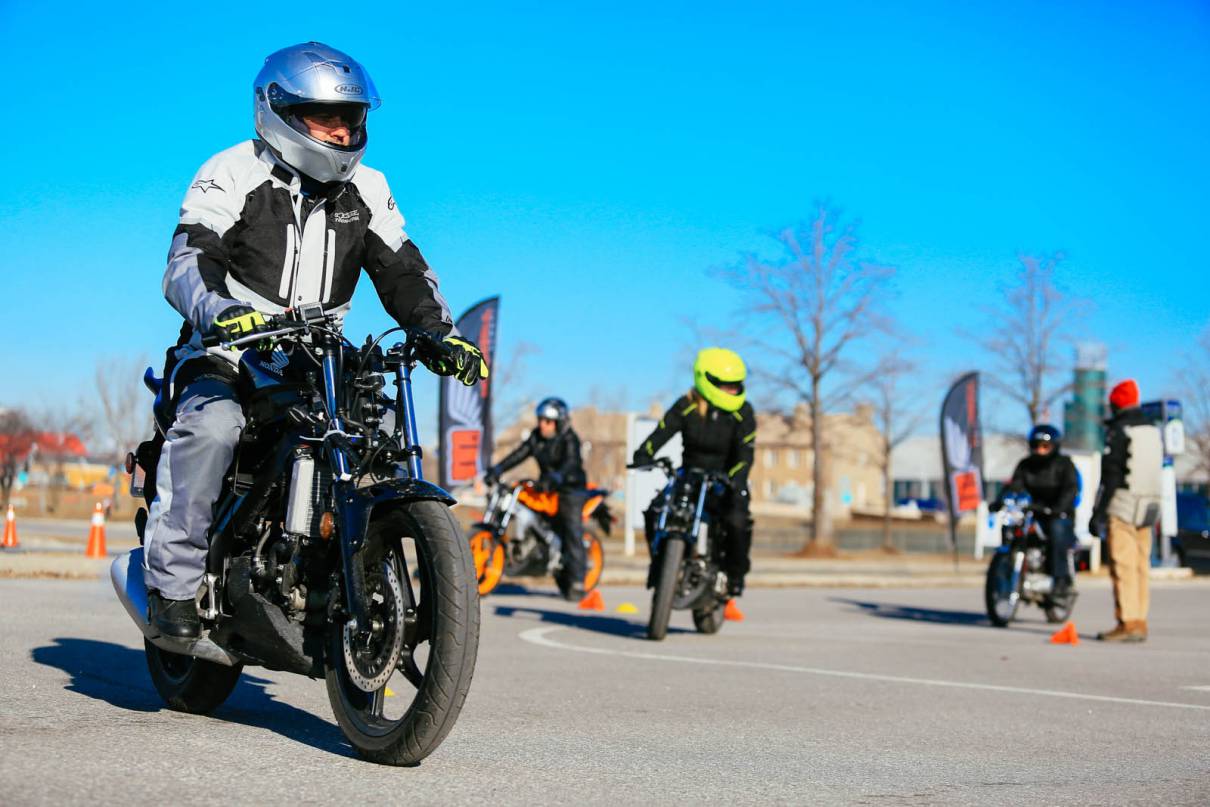
Before facing full traffic environments, riders must prove they can physically balance and control a motorcycle at low speeds. Depending on the province, this is conducted either as a standalone skills test or as the first practical road test.
- Basic Maneuvers: Examiners look for smooth clutch and throttle coordination, controlled stops without stalling, and low-speed tight turns.
- Slalom and Offset Cones: Weaving through staggered cones tests weight transfer, balance, and vision placement (looking where you want to go rather than down at the wheel).
- Emergency Braking & Swerving: Riders must accelerate to a specified speed (usually 20 to 25 km/h) and execute a controlled stop within a marked boundary or swerve around an obstacle without locking the brakes.
Many riders opt to take an accredited motorcycle safety course (such as Canada Safety Council-approved courses), which frequently incorporates this closed-course testing directly into the curriculum, fulfilling the basic skills testing requirement upon completion.
3. The Final Road Test
The culminating step to an unrestricted motorcycle licence is the advanced road test (e.g., exiting Ontario’s M2 to a full Class M, or British Columbia’s Class 6 road test).
During this assessment, the examiner typically follows behind in a car or chase vehicle, communicating instructions through a one-way radio headset.
┌──────────────────────────────────────────────────────────────┐
│                    Key Evaluation Pillars                    │
├──────────────────────────────────────────────────────────────┤
│  1. Lane Positioning   Dominant tire track; visibility       │
│  2. Observation        Regular mirror & shoulder checks      │
│  3. Speed & Spacing    Maintaining safe stopping cushions    │
│  4. Intersection Safety Clearing blind spots; left-turn cues │
│  5. Highway Riding     Merge speed matching; lane changes    │
└──────────────────────────────────────────────────────────────┘
Riders are scored on real-world decision-making:
- Lane Dominance: Ensuring you ride in the left- or right-third tire track to maintain visibility to oncoming vehicles and avoid the oil-slicked center strip.
- Head Movements: Mirror checks every few seconds and visible, deliberate shoulder checks whenever turning, merging, or changing lane tracks.
- Highway Driving: Matching traffic speed smoothly on entrance ramps, merging safely, maintaining appropriate following distances, and overtaking properly.
Provincial Licensing Comparison
| Province | Beginner Stage | Intermediate Stage | Full Licence | Notable Characteristic |
| Ontario | M1 (Written test, 90-day validity) | M2 (Post-skills test; valid up to 5 years) | Class M | Safety courses reduce the mandatory M2 wait from 22 to 18 months. |
| British Columbia | Class 6L / 8L (Knowledge test) | Class 8N (If entering via GDL) | Class 6 | Requires a distinct Motorcycle Skills Test (MST) before road riding. |
| Quebec | Class 6R (Closed-course learner) | Class 6A Learner (11-month wait) | Class 6A | Mandatory accredited driving school course (theory + track). |
| Alberta | Class 7 / Learner | Class 6 GDL | Class 6 | Upgrades involve a single, comprehensive road test on public streets. |
Preparation and Best Practices
- Invest in Proper Gear: Examiners will reject an unsafe candidate before the test begins. Arrive with an approved helmet (DOT, Snell, or ECE certified), heavy shatterproof eye protection, sturdy gloves, an abrasion-resistant jacket, heavy pants, and over-the-ankle footwear.
- Perform a Pre-Ride Inspection: Be ready to demonstrate basic bike checks to the examiner—including functioning brake lights, turn signals, horn, tire pressure, and chain tension.
- Exaggerate Head Checks: Examiners watching from a vehicle behind cannot track subtle eye movements; make distinct head turns for blind-spot checks and mirror scans.
- Enroll in a Certified Course: Formal training provides controlled practice time, teaches correct defensive habits early, and often streamlines the administrative testing pipeline with provincial transport authorities.


Happy
0 %

Sad
0 %

Excited
0 %

Sleepy
0 %

Angry
0 %

Surprise
0 %
 0
 0
More Stories
Cargo Bike Lifestyle for Families and Deliveries: The Two-Wheeled Revolution Nobody Saw Coming
Remember when a bike was just... a bike? You know, something with two wheels, a chain that occasionally slipped, and...

Bike Commuting Safety Tech and Smart Gear: The Modern Rider’s Arsenal
Remember when commuting by bike meant little more than a helmet, a flickering red light, and a silent prayer at...
Cargo Bike Conversion for Family Transportation: The Ultimate (and Honest) Guide
So, you’re thinking about swapping the minivan for something with two wheels and a whole lot more soul. Honestly, I...
DIY Bike Maintenance for Hydraulic Disc Brakes at Home: A Real-World Guide
Let’s be honest — hydraulic disc brakes are a bit intimidating at first. All that fluid, the bleeding process, the...
Cargo Bike Family Safety Tips: Ride Confident, Ride Together
Look, I get it. You’ve just dropped a small fortune on a cargo bike — that beautiful, boxy beast that...
Sustainable Practices in Bicycle Maintenance and Repair: A Greener Spin on Keeping Your Bike Rolling
Let’s be honest. When we think about the eco-friendly nature of cycling, we picture clean air, quiet streets, and a...
Average Rating